How to use Claremont Street
To use Claremont Street, enter a ticker to generate a 167-point report, then read it in three layers: quality (is the business durable?), intrinsic value (what is it conservatively worth?), and margin of safety (does the price give you room to be wrong?). Use the evidence and the verdict to inform your own decision — the platform does the research, you make the call.
Claremont Street is designed to be read like a research memo, not a signal feed. To use it, enter a ticker, generate the 167-point report, and read it in three layers — quality, value, and margin of safety — then make your own decision from the evidence. Here's how to get the most out of it.
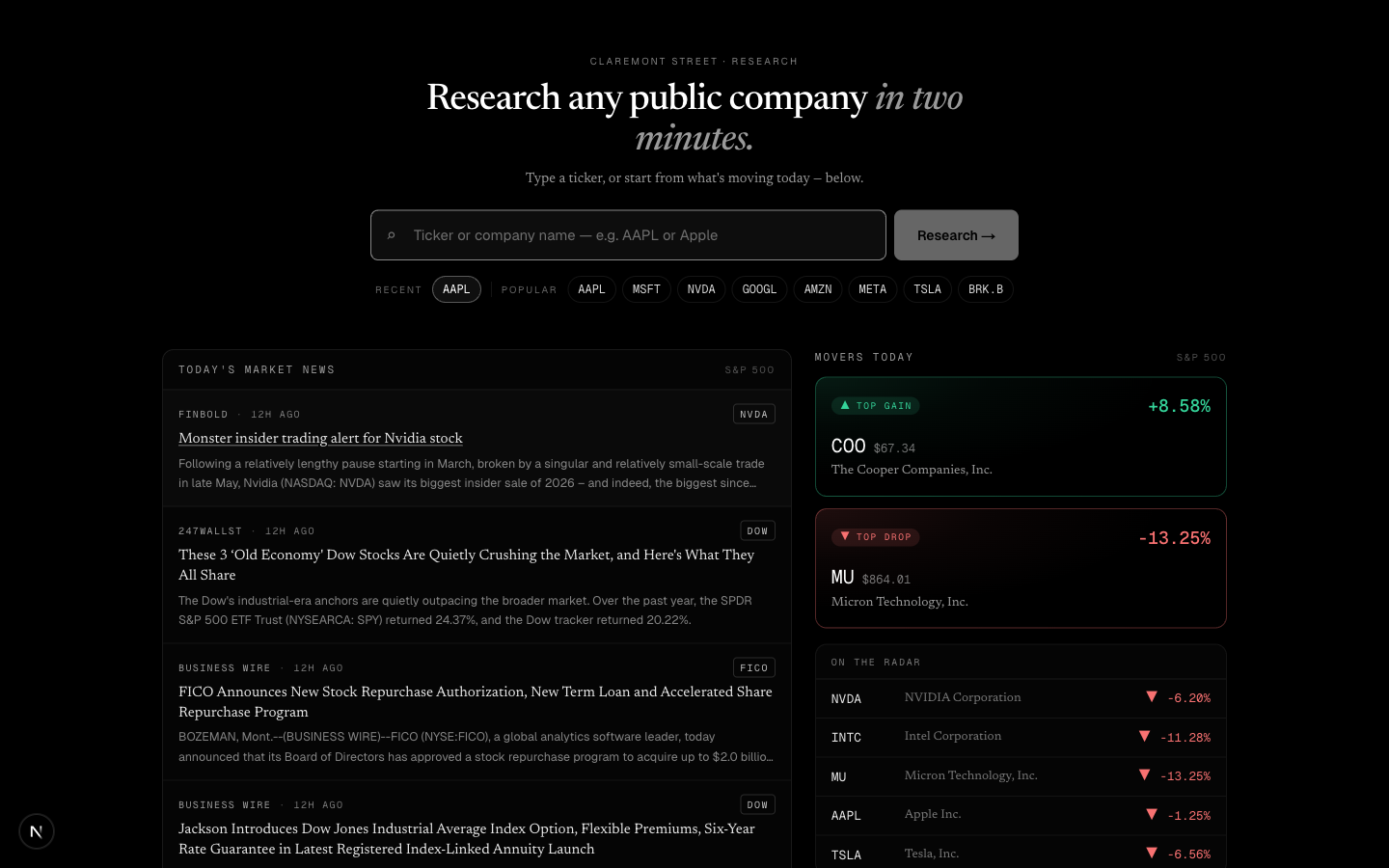
Step 1 — Run a report on a ticker
Start with a company you want to understand. Enter the ticker and the framework goes to work: it reads the filings, pulls the financials, builds a conservative valuation, and scores the business across 167 points. You get a structured report instead of a blank prompt.
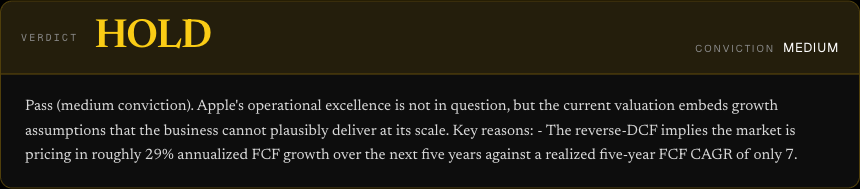
The report opens with a clear verdict and the reasoning behind it — here, a HOLD on Apple because the price embeds growth the business is unlikely to deliver at its scale.
Step 2 — Read the quality score first
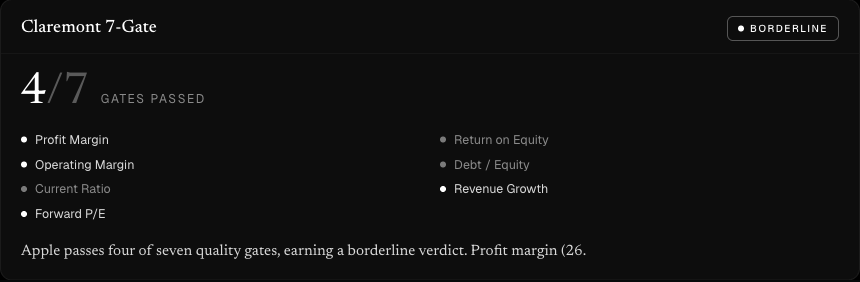
Resist the urge to jump to price. Start with quality, because that's where most of the long-term return is decided. The report lays out the evidence for a moat — return on capital over time, margin durability, the source of competitive advantage. Ask yourself: would I want to own this business for a decade even if I couldn't check the price?
Step 3 — Read the intrinsic value range
Next, the valuation. The report gives a conservative discounted cash flow and a reverse-DCF as a range, not a single number — because pretending to precision on a number built from assumptions is how investors fool themselves. Look at what the current price already implies. If it bakes in heroic growth, that tells you a lot before you read another line.

Step 4 — Check the margin of safety
This is the step that turns the report into a decision. The margin of safety is the discount between price and conservative value, and the required cushion scales with how predictable the business is. The verdict tells you whether today's price clears the bar for this specific company — wider for the uncertain ones, narrower for the durable ones.
Step 5 — Read the bear case, then decide
A good report doesn't just confirm a thesis — it attacks it. Read the risks and the weak assumptions the framework surfaces. If the business survives that scrutiny and the price offers a margin of safety, you have a candidate. The decision — and the responsibility — is yours; the platform's job is to make sure it's an informed one.
How to get the most out of it
- Compare across companies. The real power is consistency — running the same rigorous framework on many businesses surfaces the few that clear every bar.
- Revisit when the price moves. A business that wasn't cheap enough can become a buy on a selloff without anything changing but the price. Re-run the margin-of-safety check.
- Trace the numbers. Every figure is built from primary sources (SEC EDGAR, Financial Modeling Prep, Quartr) — use that to verify anything that surprises you.
FAQ
How do I use Claremont Street to research a stock?
Enter a ticker to generate a 167-point report, then read it in order — quality, intrinsic value, margin of safety — and use the evidence and verdict to inform your own decision.
What do the scores mean?
They summarize three things: how durable the business is (quality), what it's conservatively worth (intrinsic value), and whether today's price offers enough discount to that value (margin of safety).
Does Claremont Street tell me what to buy?
No. It gives you an evidence-backed view and a verdict on whether the price clears the bar, but the decision stays with you. It's a research tool, not investment advice.
Can I use it to compare companies?
Yes — and that's where it's strongest. Applying the same framework consistently across many companies is far harder to fool than analyzing them one at a time by hand.
Where do the numbers come from?
Primary sources: SEC EDGAR filings, Financial Modeling Prep data, and Quartr earnings calls, so every figure in a report is traceable.
This analysis is for informational and educational purposes only and is not investment advice. Claremont Street is not a registered investment advisor. Do your own research.
Related reading:
Patient, AI-native investing — built for the long term.
Run any stock through the 167-point framework. Free to start, no card required.